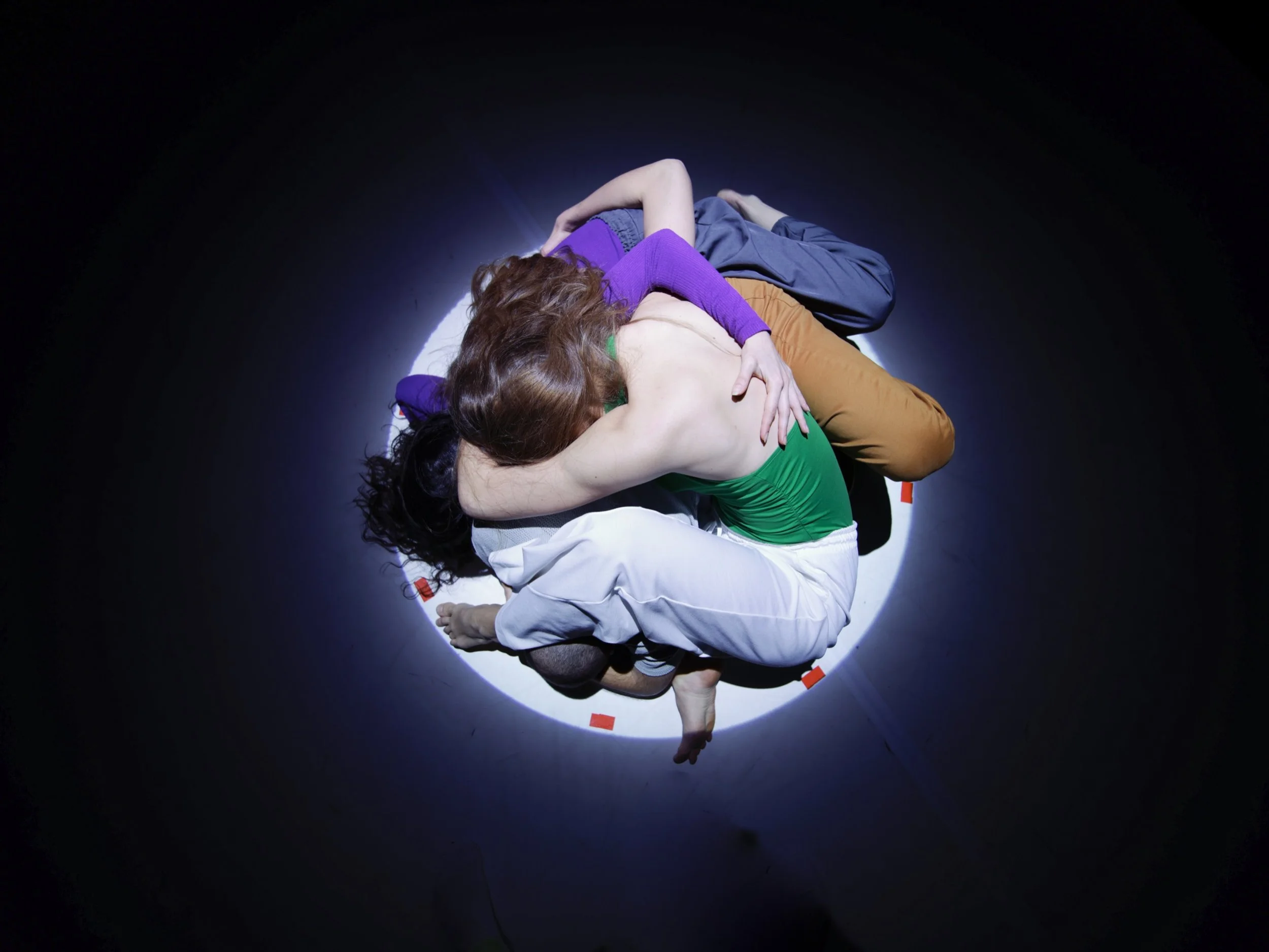
As the global population climbs, we are forced to confront the friction between individual liberties: where, precisely, does one person’s sphere of autonomy end and another’s begin? We must ask how much territory an individual truly requires to establish themselves, to exercise agency, and to find the mental stillness necessary for thought and creation.
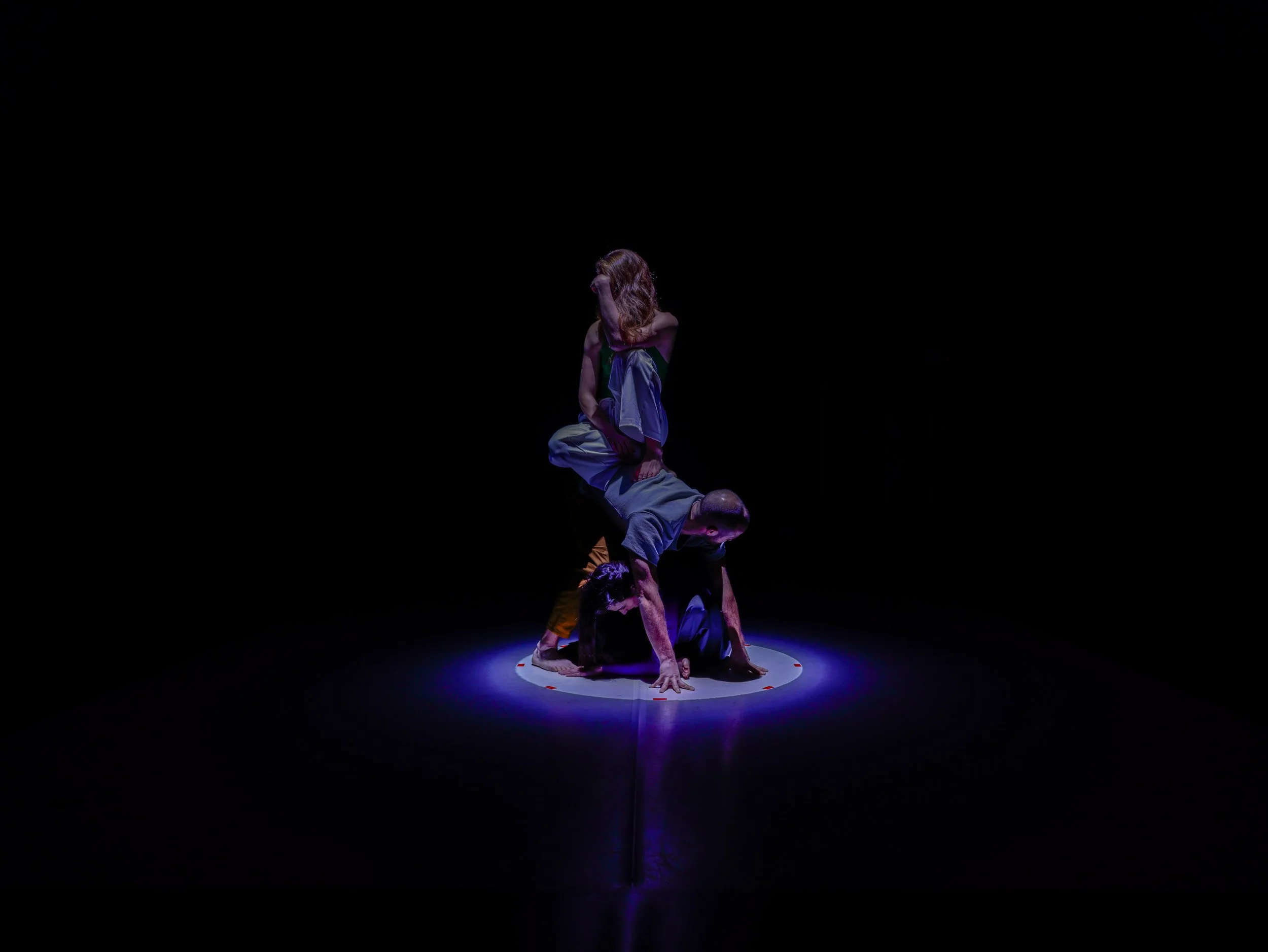
Photo by Marijo Županov
Humanity’s drive to claim and settle new territory is frequently framed as an innate instinct or a basic requirement for life. However, this impulse is driven by a fallacy: that true autonomy is only possible when we have total mastery over our environment. Vulneri suggests that our discomfort with crowds is not just about physical space, but a deeper ideological flaw—the belief that the presence of others inherently diminishes our own freedom.
Dates:
Premiere: 5. 2. 2026, Španski borci, Ljubljana
Performances: 6. & 7. 2. 2026, Španski borci, Ljubljana
Credits:
Idea and Choreography: Anamaria Klajnšček
Dance: Anamaria Klajnšček, Beno Novak, Kristýna Peldová
Music and Live Performance: Tine Grgurevič
Bowrain Costume Design: Hristijan Nashulovski
Light Design: Aljaž Zaletel
Production Coordination: Polett Kasza Producer: Žiga Predan
Produced by: Pekinpah
Co-produced by: Zavod En-Knap
Supported by: Zavod Move in Dance Izola
Supported by the Ministry of Culture Republic of Slovenia, and the Department of Culture of the Municipality of Ljubljana
To live in society, in the world, is to share space with other beings. Freedom is, in that sense, not an endless horizon of personal whim but rather a sphere, limited with and by the other who likewise inhabits that very limited space. We are observing population growth, which calls for questions such as: Where exactly does the freedom (space) of one person meet the freedom (space) of another? How wide is the space that one can inhabit, occupy, in which one can deliberate, think, and exist? The human tendency to spread across the environment – to occupy, colonise and push the limits of one’s freedom – is often disguised as a survival instinct. Behind this drive is often the illusion that freedom exists only where we have absolute control. Vulneri is thus not merely an observation of physical oversaturation but also a symptom of an ideological paradigm, i.e. the assumption that the surplus of others necessarily means lack of freedom.
Anamaria Klajnšček addresses these topics on a physical and material level – by placing three dancers within a single square meter, where they cohabitate, coexist, and share the space while, precisely within these limits, seeking freedom. Klajnšček brings into the space a series of movement, dance, and somatic techniques that she has been exploring for the past seven years. We are looking at bodies in constant movement, engaged in active tactile listening and role-switching. The performance reveals the fragile architecture of human codependence.
The dancers’ cohabitation in an extremely small space strips the concept of freedom of its abstraction. The limits between the freedom of one person and that of others are made perfectly clear. While the terror and imperialistic expropriation of space and freedom are, as history (and, alas, the current situation) shows, always a (terrible) option, the dancers in Vulneri hint at a viable alternative: sensibility and solidarity. But these call for a full understanding of the concept of cohabitation. They demand subtlety of movement (i.e., of thinking), plasticity of bodies (i.e., of thinking), and collaboration among bodies (i.e., among people). For if two out of three people on a single square meter of surface fail, if the power relations destroy them, the third person simply becomes alone. Does being the only one still include the concept of freedom?