
Watching an audience watching Dance, or being in proximity to a dancer, is a completely different experience. It is precisely this different experience, even though it is the same dance, manifesting in the same space and at the same time, that I call Dance. This dance is, in my opinion, the most magical form of art. - Matej Kejžar for Jutarnji List
Kejžar is the receiver of the prestigious Croatian Actor Award
(Nagrada Hrvatskog glumišta) for Best Dance Performance in its entirety
for the Zagreb edition of House Bolero.
“My motivation is to learn from Dance – that is, to learn from my fellow dancers. With such an approach, the hierarchical relationship between choreographer and dancers, which of course exists and is part of broader socio-political structures, begins to dissolve. Patriarchy sucks!” said Matej Kejžar upon receiving the prestigious Croatian Theatre Award (Nagrada Hrvatskog glumišta) for House Bolero.
With this piece, Kejžar also confronts generational hierarchies. House Bolero is a transgenerational artistic experiment centred around one essential question: how can we learn from Dance? The performance brings together dancers ranging in age from 21 to 69. “I was intrigued by how to write a story about dance together with dancers who have been performing for twenty years longer than I have (pure respect!) and, at the same time, with younger ones whose energy feels deeply enthusiastic and curious,” explains Kejžar. “In this way, we developed Bolero’s own diction.”
This diction emerged through dialogue, i.e. from collective discussions and one-on-one exchanges. Conversation, as a fundamental building block of civilisation, intertwines in House Bolero with the instability and fluidity of dance and with the body’s passion for movement. The dancers shape complex and nuanced modes of physical presence that spark new questions and point toward an ever-unfinished, yet exciting definition of dance as a force that resists normalisation – both in society and in art.
It is significant that Kejžar insists on writing Dance with a capital “D”. He approaches the concept in the same way he observes Digitality, which he sees not merely as digital technology, but as a force seeking to act upon the body’s illogical thoughts. Dance and Digitality are in constant confrontation. While choreography is a form of control, this does not mean that unchoreographed Dance lacks meaning. Even the seemingly arbitrary – the “anything” one might wish to attribute to movement – is always already something.
As is characteristic of Kejžar’s work, the audience is not excluded from the conceptualisation of the piece; it is never a passive recipient. “What interests me is how to live dance, not just perform it. My goal was – and still is – to carry this experience over to the audience, so that they too become part of Dance itself. Everyone who is physically present in a given space and time is part of this dance. Watching dance from a distance or being in close proximity to the dancers are entirely different experiences.”
CREDITS
Author: Matej Kejžar
Dancers: Georgeta Capraroiu, Christian Guerematchi, Polett Kasza, Gregor Luštek, Goran Tatar, Urša Vidmar, Mateja Železnik
Set & Lights: Petra Veber
Costumes: Tina Paulin, Matej Kejžar
Producer: Žiga Predan
Production: Pekinpah & SNG Opera Balet Ljubljana
Supported by: GO! 2025, Embassy of the Republic of Slovenia in Brussels, SNG Opera Balet Ljubljana
Premiere: 1. October 2025, Les Brigittines, la Chapelle Petite rue des Brigittines, Brussels, Belgium


Matej Kejžar (1974) is a graduate of SNDO in Amsterdam and a dance artist who consistently develops his signature approach through the exploration of the relationship between body and digitality, as well as the power dynamics that emerge through rigid choreographic control over movement. He furthered his education at P.A.R.T.S. in Brussels and with the Trisha Brown Dance Company in New York. Kejžar is the recipient of the Croatian Theatre Award (Nagrada Hrvatskog glumišta, 2024) and the Ksenija Hribar Award (2023) for his body of work, praised as “an outstanding dancer and a visionary creator who inspires.” Over the past decade, he has developed his oeuvre between Brussels and Ljubljana while regularly working worldwide (India, Singapore, Brazil). He is the artistic director of the international Spider Festival and a dance pedagogue at SNDO and numerous other dance institutions.
Georgeta Capraroiu completed her ballet school in Cluj-Napoca. In 1989, she got her first engagement at the National Opera in Cluj. She left Romania in 1993 and joined the SNG Opera Maribor, where until 1995 she danced various roles in ballet and drama performances, including the main role in the drama performance Moon over Mississippi, the Director in Graduation Ball (Ples kadetov), Autumn in the ballet triptych Four Seasons (Štirje letni časi), and also acted in Tomaž Pandur's production The Divine Comedy (Božanska komedija - La Divina Commedia) and Paolo Magelli's Oresteia. In 1995, she moved to Ljubljana and joined the ballet ensemble of the SNG Opera and Ballet Ljubljana, where she dances to this day. Among her most important roles are: the main role in the ballet One – Baccherolette, the role of Lola in the ballet Coppélia on Montmartre (Coppélia na Montmartru), the Bluebird in The Sleeping Beauty (Trnuljčica), a solo role in the ballet Architecture of Silence (Arhitektura tišine), the Spanish Dance and Pas de trois in Swan Lake (Labodje jezero), and the role of Katherina in the ballet The Taming of the Shrew (Ukročena trmoglavka). In 2000, critics from the prestigious magazine Dance Europe proclaimed her interpretation of Katherina in The Taming of the Shrew as the Best Role of the Year.
Christian Guerematchi is a Slovenian-born Dutch choreographer and performer with a background in ballet and contemporary dance. He danced with the National Ballet in Maribor under the direction of Edward Clung, after which he moved to the Netherlands with ICK Amsterdam. In 2012, he was nominated for 'De Zwaan' Best Dance Performance for his role in ROCCO by Emio Greco and Pieter C. Scholten. His making started with White Noise (2019) i.c.w. Otion and in 2020 Christian made his solo performance N.A.M. - Non Aligned Movement; an afro-futuristic journey to the Balkans. In the Netherlands he worked with choreographers such as Stephen Shropshire, Emio Greco | Pieter C. Scholten and Nicole Beutler. He is fascinated by human existence and the social structures involved. Skin colour, and in particular the black body in a world where white culture predominates, sexual orientation and gender are themes that emerge repeatedly in his work.
Polett Kasza is a Ljubljana–Budapest–based freelance dancer, cultural manager, and intimacy coordinator for film and television.
After graduating from the Hungarian Dance University in Budapest with a Bachelor’s Degree in Dance, she began her professional career with the Czech National Ballet in Prague in 2011. She later joined the Slovenian National Opera and Ballet in Ljubljana, where she was promoted to a demi-soloist position. Following that she continued her career at the Hessisches Staatsballett in Wiesbaden-Darmstadt as a soloist in 2016, where she expanded her work into contemporary dance theatre. Since 2018, Polett has been working as an independent artist, collaborating with Beatrix Simkó (HU), Kristina Aleksova (SLO), Katia Engel (DE), Jenna Jalonen (FI), Sanja Nešković Peršin (SLO) and Matej Kejžar (SLO). She has been invited to perform as a guest artist in Belgium, Sweden, Japan, Indonesia, Switzerland, Ukraine, South Korea, Italy, Spain, Austria, and the Czech Republic. In 2023, she directed and choreographed her first dance performance, SQUARE 1, in collaboration with Mateja Železnik. She proudly received her second diploma in cultural management in 2024. She has been working closely with the Slovenian Pekinpah Association and Spider Festival. Polett further expanded her expertise by completing training as an Intimacy Coordinator through Safe Set's SAG-AFTRA-accredited program in 2025, since then she has been working with internationally acclaimed film directors and actors.
Gregor Luštek (1973) studied at the Faculty of Sport in Ljubljana. His dance knowledge is a blend of various techniques, ranging from classical ballet to contact improvisation, somatic practices, and martial arts. Working in a creative tandem with choreographer and dancer Rosana Hribar, he has received numerous national awards (the Trdina Award of the Municipality of Novo Mesto, the Župančič Award of the City of Ljubljana, the Prešeren Fund Award, etc.). As a choreographer, he also received the Sterija Award for stage movement in a theatre production abroad. With more than 30 years of teaching experience, he has led numerous seminars and workshops in Slovenia (including at Alma Mater Europaea – Academy of Dance) and internationally (for example at the Latvian Academy of Culture, SNDO, and the Beijing Dance Academy).
Goran Tatar completed his secondary school education at the Secondary School of Music and Ballet in Ljubljana. He has been a member of the SNG Opera and Ballet Ljubljana since 1991. Since 1999, he has also been a co-founder of Fičo Ballet. He participates as a regularly employed dancer in the productions of the SNG Opera and Ballet Ljubljana, as well as in non-institutional performances and projects. In his 35 years of activity in ballet and dance, he has collaborated with a number of renowned domestic and international choreographers and directors: Pia and Pino Mlakar, Henrik Neubauer, Janez Mejač, Vlasto Dedović, Toer van Schayk, Julio Lopez, Ksenija Hribar, Youri Vámos, Georgette Tsinguirdes, Goran Bogdanovski, Tanja Pezdir, Gagik Ismailian, Mateja Bučar, Torsten Händler, Irek Mukhamedov, Frank Andersen, Lynn Charles, Jiři Bubeniček, Ivan Peternelj, Kristina Aleksova, Barbara Novaković, Iztok Kovač, Matjaž Farič, Edvard Clug, Matej Kejžar, Lukas Zuschlag, Renato Zanella, Slobodan Maksimović, Gregor Luštek, Rosana Hribar, Leo Mujić, Sanja Nešković Peršin, and many others. It was also an honor for him to collaborate with the recently deceased director Robert Wilson.
Urša Vidmar, the daughter of a Slovenian ballet couple, chose a career in ballet. In 1994, she graduated under Professor Maruša Vidmar, and in the same year, she became a member of the SNG Opera and Ballet Ljubljana ensemble, where she is still active today, having furthered her education through seminars abroad. Her ballet debut was in 1998 as Juliet in Romeo and Juliet (Istvan Herczog). Her recognizable artistry was highlighted in key roles such as Cinderella in Cinderella (Jean Christophe Blavier), The Bride in Les Noces (Svatba, Jiri Kylian), Bianca in The Taming of the Shrew(John Cranko), and Effy in La Sylphide (August Bournonville). She collaborated with a range of renowned domestic and foreign choreographers, including Leo Mujić, under whom she debuted in stage speech with the role of Marina in The Lonely Poet. For her portrayal of Cinderella and Effy, she received the Lydia Wisiak Prizes. She has also performed outside of the SNG Opera and Ballet and toured in the USA.
Mateja Železnik (1992) is a dancer with a diverse background in various dance styles and over fifteen years of performance experience. After completing her classical ballet education at the Ljubljana Conservatory of Music and Ballet, she was a member of Kara’s Dance Project, Elephant in the Black Box Junior Dance Company, and the Slovenian Youth Ballet. In 2017, she joined the SNG Opera in balet Ljubljana (Slovenian National Theatre Opera and Ballet Ljubljana), where she worked as a dancer, co-creator, and choreographic assistant. She has danced in numerous performances produced by SNG Opera in balet Ljubljana, SNG Maribor Ballet, and various producers on the contemporary dance scene. She is a long-time collaborator of choreographers Lukas Zuschlag, Sanja Nešković Peršin, and Kjara Starič Wurst. Since 2023, she has been working as an independent artist in Ljubljana. In the same year, she created her first original dance project, Kvadrat1(Square1), in collaboration with Polett Kasza.
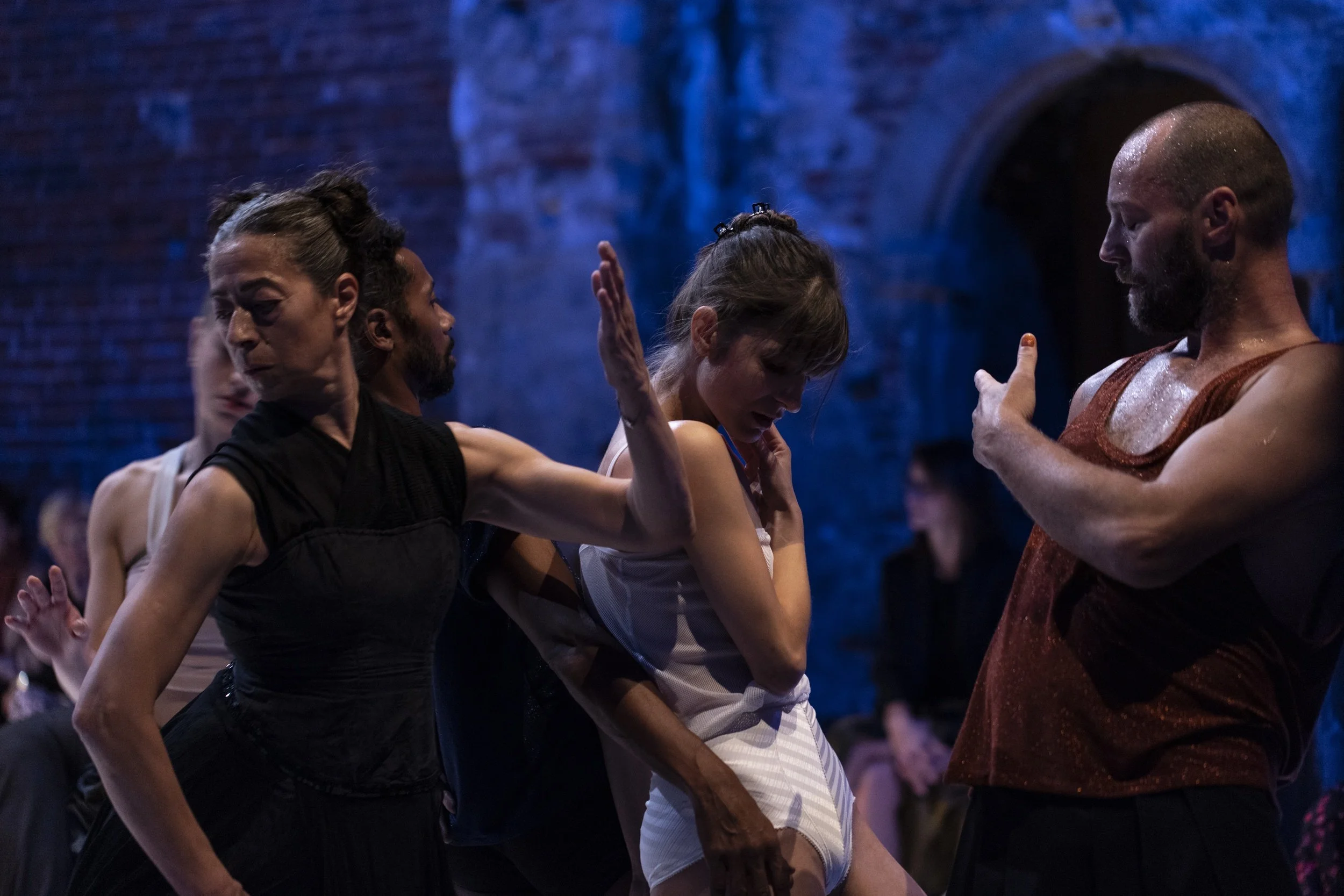
Photo by Matija Lukić